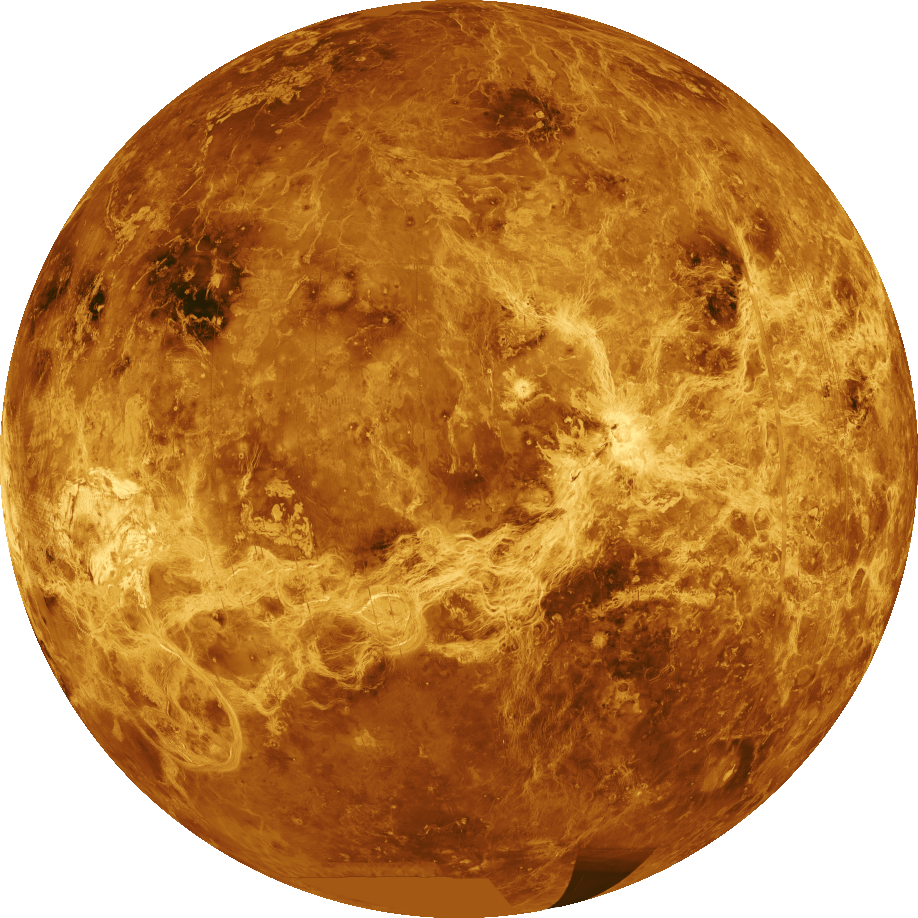
Venus
The powers of Earth have started terraforming of Venus. However, unlike Mars, it will take humanity a very long time to complete the project.
Phase 1 - Preparation & Cooling (0-60 years)
- Build vast orbital mirrors to block sunlight and cool Venus.
Atmosphere slowly cools while remaining dense.
Phase 2 - The Great Flood (≈60-90 years)
- At 31°C, CO₂ liquefies → begins raining down for ~30 years.
- Global cooling accelerates.
- Pressure drops; Venus becomes covered in liquid CO₂ oceans.
Phase 3 - The Big Freeze (≈90-150 years)
- Surface cools to −81°C.
- CO₂ oceans freeze into rock-hard ice and glaciers.
- Atmosphere left with nitrogen at ~3× Earth pressure.
Phase 4 - Atmosphere Management (150-500+ years)
- Prevent frozen CO₂ from re-vapourising:
- Options: insulate, bury, or eject into orbit with mass drivers.
- Import water from Europa (via tethers, mass drivers).
- Balance nitrogen levels by exporting excess gas into space.
- Venus becomes a world of shallow frozen oceans, continents, and islands.
Phase 5 - Light & Heat Regulation (Centuries Later)
- New orbital mirrors provide controlled sunlight and artificial day-night cycles.
- Begin thawing water oceans.
Phase 6 - Biosphere Seeding (1,000-3,000+ years)
- Introduce cyanobacteria → oxygen production and nitrogen fixation.
- Fertilisation of oceans.
- Grind surface rock into soil for nitrogen-fixing plants.Spread forests and
- vegetation.
- Release controlled amounts of CO₂ for plant growth.
- Possibly engineer new life adapted for Venus.
Phase 7 - Human Habitation (Several Thousand Years)
- Atmosphere becomes breathable for humans.
- Only oxygen masks needed before full conversion.
- Ecosystems flourish with animals and plants.
- Cities and societies develop on a lush, Earth-like Venus.
Summary
- Hundreds of years → Freeze Venus and import water.
- Thousands of years → Create oxygenated, habitable biosphere.
- End state: A second Earth capable of sustaining billions of humans.
Source: How To Terraform Venus (Quickly)